Who Owns OpenAI? The 2026 Ownership Explained
When was the last time you used ChatGPT to write an email, fix a piece of code, or help you plan a weekend trip? Today, we can’t even imagine a day without using any AI tool. It feels like a helpful, invisible assistant right inside your phone. But have you ever wondered who actually pulls the strings behind this world-changing technology?
The question of who owns OpenAI isn't as simple as it might seem, because it didn't start in a typical corporate boardroom. It began as a small, shared dream among a few scientists who wanted to keep artificial intelligence safe for everyone. Today, that small project is worth a massive $852 billion. For anyone who uses AI in their daily life, knowing who owns OpenAI matters because whoever holds the keys ultimately decides how this technology will shape our jobs, our schools, and our future.
What Kind of Company Is OpenAI?
OpenAI is not a traditional startup or a typical publicly traded company. In mid-2025, the organisation completed a massive corporate restructuring. It officially transitioned from its old "capped-profit" model to a full-for-profit Public Benefit Corporation (PBC), known as the OpenAI Group PBC.
A Public Benefit Corporation is a unique setup. It means the company is legally required to balance financial returns for investors with a broader mission to help society. Because of this protective corporate shield, a regular outside buyer cannot simply come in and purchase OpenAI like a standard business.
The OpenAI Foundation: Who Really Controls the Wheel?
To truly grasp who owns OpenAI, you have to look at the very top of its corporate ladder. The entire ecosystem is governed by the non-profit OpenAI Foundation (OpenAI Inc.).
OpenAI Ownership Structure & Voting Power
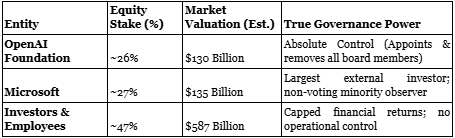
Even though the OpenAI Foundation holds an equity stake of approximately 26%, it retains absolute voting control over the for-profit arm. The OpenAI Foundation has the sole power to appoint or remove every single member of the board of directors at any time. This setup ensures that regardless of who holds the most shares, the core mission of developing Artificial General Intelligence (AGI) for the benefit of humanity remains completely protected.
Who Are OpenAI's Founders?
OpenAI was co-founded in December 2015 by a group of high-profile tech leaders, including Sam Altman, Greg Brockman, Elon Musk, Reid Hoffman, Ilya Sutskever, and Peter Thiel. It originally launched as an open research lab with $1 billion in initial funding commitments from its founders.
Does Sam Altman Own OpenAI?
For a long time, the answer to who owns OpenAI did not include its own chief executive. Even after being one of the founding members of OpenAI, Sam Altman had no equity shares in the company for a long time. Famously held no direct equity in the company for years, choosing instead to focus entirely on the mission.
However, as part of the 2025 for-profit corporate restructuring, Sam Altman received a 10% equity stake. Based on OpenAI's recent $852 billion market value, his share is worth a massive $85 billion. This late equity grant is highly unusual compared to typical tech startups, where founders secure massive chunks of stock on day one.
Microsoft's Stake: The Largest External Investor
If you ask financial experts on Wall Street who owns OpenAI, most will point directly to Microsoft.
After a major corporate restructuring in 2025, Microsoft now holds about a 27% stake in the for-profit branch of the company.
In total, Microsoft has invested around $13 billion across multiple funding rounds. However, their partnership goes much deeper than just owning shares. Microsoft also serves as OpenAI’s primary cloud provider, powering its massive AI systems on Microsoft Azure. Even though Microsoft's share percentage dropped slightly when OpenAI raised massive new funding in early 2026, it remains the most important corporate partner in the entire ecosystem.
The Historic $122 Billion Funding Round (March 2026)
In March 2026, OpenAI closed a record-shattering $122 billion funding round, sending its post-money valuation to $852 billion. This capital injection completely changed the math of who owns OpenAI across the venture capital landscape.
SoftBank, Thrive Capital, and Tiger Global came as the key institutional investors, bringing mega funds and pouring billions.
Infrastructure, fuel, and funding are being actively deployed to the "Stargate" initiative, a $500 billion data centre project in partnership with Oracle and SoftBank.
Reports show massive revenue growth as OpenAI is now generating roughly $2 billion per month as of early 2026, driven by enterprise AI adoption.
Can You Buy OpenAI Stock?
Currently, everyday retail investors cannot buy OpenAI stock. It remains a privately held company, meaning there is no official ticker symbol on Nasdaq or the New York Stock Exchange.
The only direct equity holders are select venture capital funds, institutional partners, and employees. For regular investors seeking exposure, the most common proxy strategy is buying Microsoft (MSFT) stock, given its massive 27% financial stake in the business. However, things are shifting quickly; OpenAI confidentially filed for a historic Initial Public Offering (IPO) targeting a valuation well above $1 trillion.
The Ongoing Tension: Mission vs Profit
The unique division of power creates a continuous tug-of-war between commercial success and ethical safety. The non-profit ideology of OpenAI Foundation sits at the apex, ensuring that safety guardrails override pure shareholder interests.
This structure means that even if a trillion-dollar investor wants to push a product to market faster to generate profit, the board backed by the foundation can legally say no. It remains one of the most unique experiments in corporate governance history.
So, when it comes down to the bottom line, who owns OpenAI?
The real answer is that no single person, tech conglomerate, or government owns OpenAI. It is a carefully engineered corporate web in which a non-profit mission holds the steering wheel of an $852 billion commercial powerhouse. As OpenAI edges closer to its massive trillion-dollar public market debut, the world will watch to see if this historic structure can successfully bridge the gap between massive financial scale and its original safety mission.
Abhyuday
Staff Writer