Joe Rogan Spotify Deal: What the $250 Million Renewal Costs
The WSJ-reported $250 million is a multi-year sum. Against Spotify's ad-supported segment, with €330 million of 2025 gross profit, it is sizable, not huge.
Senior Markets Correspondent
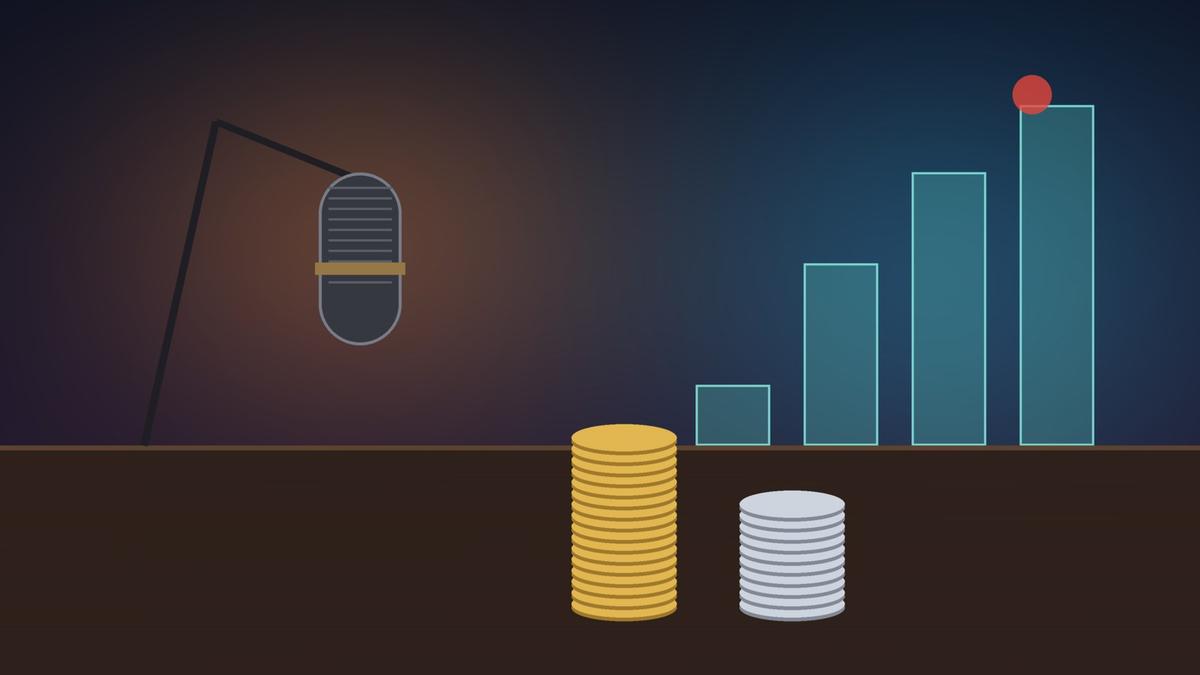
Illustration of a studio microphone on a boom arm at night beside a tall stack of gold coins and a shorter silver stack, with a rising bar chart glowing behind. Illustration: TradeFlock USA
Spotify's own filings put a price tag on the Joe Rogan Spotify deal that the headlines skip. The reported $250 million earnout, paid over a multi-year term Spotify has not disclosed, equals about two thirds of one year of gross profit at Spotify's ad-supported business; if the term runs three years, an assumption, it would be about €74 million a year, or about 23% of 2025 segment gross profit, TradeFlock calculates. The deal lands after Spotify spent two years cutting its yearly podcast content amortization by 40% and shrinking capitalized podcast content on its balance sheet to just €20 million. The renewal is a bet that one show can still pull weight in an ad segment Spotify spent three years making lean.
What Spotify Confirmed on Thursday
Spotify announced the renewal on Thursday, October 8, 2026, calling it "a new multi-year licensing agreement" for The Joe Rogan Experience. In its newsroom post, the company said the show has 18 million followers and has been the most followed show on Spotify since the partnership began in 2020.
Spotify did not disclose the price, the length of the term, or how payments are structured. The number in circulation comes from The Wall Street Journal, which broke the story that morning. Citing unnamed sources, the Journal reported that Rogan is set to receive "an estimated earnout of $250 million" over the term, according to Variety's account of the report. Variety added that Spotify will keep handling ad sales and licensing for the show.
The word earnout suggests part of the money depends on performance. The deal amount, the most searched detail this week, is an estimate, not a disclosed figure.
The Journal put the same figure, up to $250 million, on Rogan's February 2024 renewal, which Spotify told Reuters at the time was incorrect. If both estimates hold, the price of keeping the show has stayed flat since 2024, after the original 2020 exclusive was reported at about $100 million, as the Los Angeles Times noted in its coverage of the renewal.
The Podcast Bill Spotify Already Cut
Spotify spent the years after its exclusive era cutting podcast costs. Its annual report on Form 20-F for 2025, filed on Tuesday, February 10, 2026, describes how the company accounts for shows it produces or licenses. License fees, production costs and participation minimum guarantees are capitalized as podcast content assets and then amortized, usually within three years and on an accelerated schedule because most listening happens soon after release.
That amortization line tells the story. Spotify charged €208 million of content asset amortization to cost of revenue in 2023, €188 million in 2024 and €125 million in 2025. That is a 40% drop in two years, TradeFlock calculates. The pullback started with what the filing calls a 2023 "strategic realignment and reorganization plan focusing on podcast operations and rationalizing our content portfolio," which came with €29 million of content write-offs.
Spotify's interim report for the quarter ended June 30 shows €52 million of content asset amortization in the first half, down from €66 million a year earlier. Capitalized content assets on the balance sheet stood at €20 million at the end of June, down from €28 million at the end of 2025 and €47 million at the end of 2024.
The 20-F explains why: Ad-Supported cost of revenue fell by €119 million in 2025, "driven primarily by a reduction in podcast costs of €83 million due primarily to our optimization of podcast inventory as well as costs attributable to the new video podcast experience available to subscribers to our Premium Service now recorded to the Premium segment." Part of that drop is a reclassification, not a saving.
How $250 Million Compares With the Ad Segment
Under Spotify's segment rules, podcast content costs sit in the Ad-Supported segment, except for costs tied to the video podcast experience for Premium subscribers, which have been booked in Premium since 2025. Because Spotify sells the ads on Rogan's show, this is where the deal has to earn its keep.
Here is how that segment has moved, using the figures reported in the 2025 annual report, with margins TradeFlock calculates:
- 2023: revenue of €1,681 million and gross profit of €62 million, a margin of about 4%
- 2024: revenue of €1,854 million and gross profit of €229 million, a margin of 12%
- 2025: revenue of €1,836 million and gross profit of €330 million, a margin of 18%
Revenue grew about 9% from 2023 to 2025. Gross profit grew more than fivefold, TradeFlock calculates. Nearly all of that came from spending less. In the second quarter of 2023, the segment posted a gross loss of €23 million, a margin of negative 6%, which Spotify's report for that quarter blamed on content write-offs, severance and contract terminations.
Now convert the Journal's estimate. At the European Central Bank reference rate of $1.1206 per euro on Friday, October 9, $250 million is roughly €223 million. That equals about 68% of the segment's 2025 gross profit, and about 1.7 times the €135 million of gross profit it made in the first half of 2026, TradeFlock calculates. If the term runs three years, an illustrative assumption because Spotify has not disclosed it, that is about €74 million a year.
The comparison has limits. The money is spread over a term of undisclosed length, part of it may be contingent, and the show also generates ad revenue that offsets the cost. Spotify also recast its segments on January 1, 2026, moving some revenue from Ad-Supported to Premium, so 2026 figures are not directly comparable with earlier years.
Against the whole company, the deal is small. Spotify reported free cash flow of €797 million in the second quarter and €3.3 billion over the trailing twelve months in its Q2 2026 shareholder update, released on Tuesday, August 4. The full estimated payout is about 7% of one year of that cash flow, TradeFlock calculates. The harder question is whether it pays back inside the segment that carries it.
Why the Ad Market Makes This Harder
The timing is awkward for the ad side. The 2025 annual report says Ad-Supported revenue fell €18 million, with direct music channels and ad sales from podcasts down €116 million "due to a decrease in fixed-CPM rates as well as a decrease in music impressions sold." Automated, auction-based sales grew €103 million and filled most of the gap.
That shift continued this year. In the second quarter of 2026, the interim report shows Ad-Supported revenue rose 1% to €446 million, with automated channels up €75 million and the direct channel down €66 million. The segment made up 9% of Spotify's total revenue of €4,777 million.
A marquee show is the kind of inventory that can command premium, directly sold rates, and Variety says Spotify handles ad sales for a show that runs on multiple services, not only inside its own app. If direct and podcast ad pricing keeps sliding, that case gets harder to make.
The deal also sits alongside a different podcast strategy. Spotify now pays creators through its Spotify Partner Program, launched in January 2025 in four markets, which pays creators based on video viewing of their shows. TradeFlock reported in September that Spotify was expanding its podcast partner program to 35 new countries. Those costs run through Premium, where the gross margin was 34.9% in the second quarter, TradeFlock calculates from the interim report.
A Crowded Field for Podcast Listeners
Spotify's catalog holds 7 million podcast titles, according to the annual report, and rivals keep courting hosts. Meta has been rolling out podcaster features on Threads. Like its long-term music agreements, such as the Spotify and UMG deal, the renewal secures content through a multi-year license rather than ownership.
What to Watch on October 22
Spotify will post its third quarter results before the market opens on Thursday, October 22, 2026, according to the company's earnings date release. Three lines will show how the Rogan deal is landing.
First, the content assets figure in the notes. If the renewal includes upfront fees or minimum guarantees, Spotify's accounting policy says they are capitalized, and the €20 million balance would likely rise. Fixed access fees, by contrast, are expensed evenly over the license period and would not show up there.
Second, Ad-Supported gross margin. It was 19.1% in the second quarter, TradeFlock calculates. A sharp drop without a matching revenue jump would suggest the new deal costs more than it earns in the near term.
Third, the split between direct and automated ad sales. A recovery in the direct channel would support the case that a flagship show still lifts premium ad pricing.
Until Spotify says more, the clearest read on the deal is one comparison: a reported $250 million commitment against an ad segment that made €330 million of gross profit last year.
Illustration: TradeFlock USA
Elena Vasquez
Senior Markets Correspondent
Covers Treasuries, the dollar, and the policy signals that reprice risk assets.