Nvidia Nemotron 3.5 Super VL and Bolt: Hardware and License
Nvidia's model cards show Super VL fitting on one GB200 or DGX Spark in NVFP4 form, Bolt packed into 24GB, and a switch to the Linux Foundation's OpenMDW license.
Technology Editor
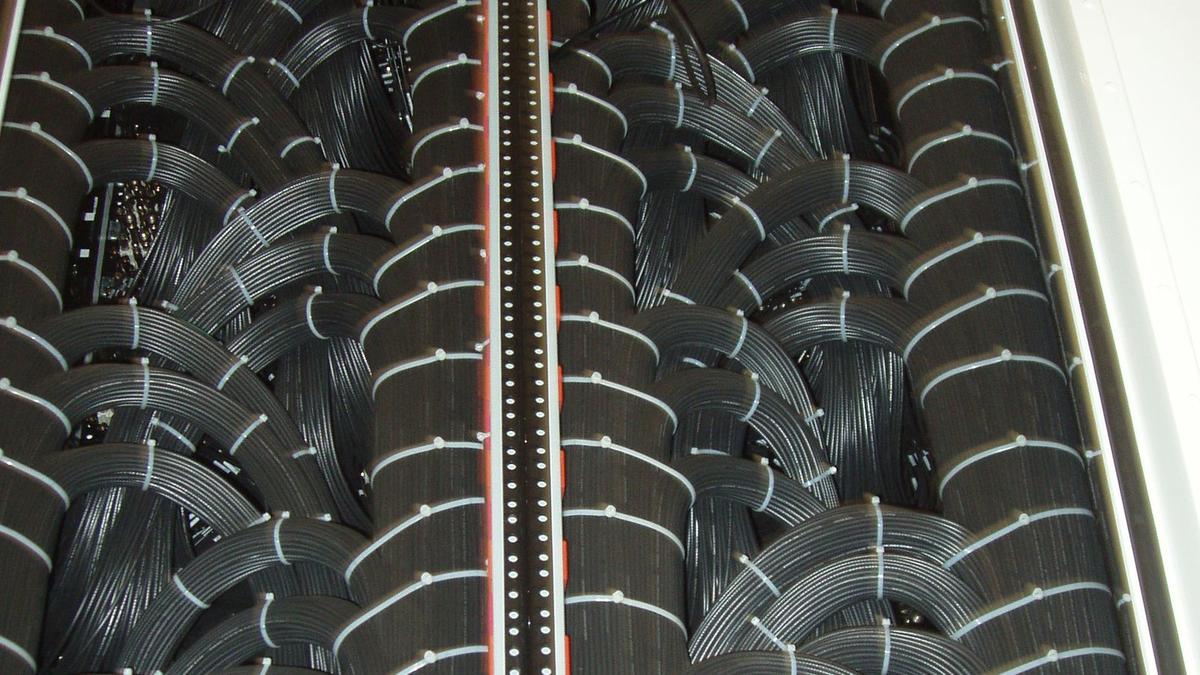
Photo: Pcpeggs / Wikimedia Commons, public domain
Nvidia Nemotron 3.5 arrived on Oct. 15 with a pitch about agents that run anywhere, from data center racks to a desktop. Nvidia's launch post, published at about 11 a.m. ET that day, introduced Nemotron 3.5 Super VL and Nemotron 3.5 Bolt 74B-A9B 24GB, with a smaller Bolt E4B 4GB model due Oct. 23. Coverage, including TechCrunch on Oct. 19, has focused on speed and customers. Two details in Nvidia's own documents have drawn less attention: the hardware each model actually needs, and the license that now governs the family.
What Nvidia Released
According to Nvidia, Super VL is a vision language model with 120 billion total parameters, of which 12 billion are active for any given token. The company says it handles instruction following, tool use, multistep business workflows and visual understanding "comparable with NVIDIA's largest reasoning model at roughly one-fifth the parameter count." That larger model is Nemotron 3 Ultra, which Nvidia lists at 550 billion total and 55 billion active parameters. By TradeFlock's calculation, 120 billion is about 22% of 550 billion.
Nvidia's research page for the release states that Nemotron 3.5 Super scores 51.78% on SWE-bench Pro, a software engineering test, "surpassing Nemotron 3 Ultra while using approximately 4.6× fewer active parameters." The same page says the compressed NVFP4 version recovers 99.62% of the full precision model's accuracy, measured as a median across 36 benchmarks. These are Nvidia's own results. TradeFlock has not independently tested the models, and the launch post's headline claim of "5x faster" performance is likewise Nvidia's characterization.
The Hardware Ladder
Nvidia's Hugging Face model cards spell out deployment targets. File sizes below are the totals of each repository's weight files as listed on Hugging Face, summed by TradeFlock.
Nemotron 3 Ultra in NVFP4 form carries about 352 GB of weights. Its card lists a minimum of four GB200, B200, GB300 or B300 GPUs, or eight H100s.
Super VL at full BF16 precision carries about 249 GB of weights, and its card lists four H100s or two GB200s.
The NVFP4 version of Super VL shrinks that to about 75 GB. Its model card lists a single DGX Spark, a single H200, two H100s or a single GB200. The earlier flagship it is benchmarked against needs at least four data center GPUs.
Bolt goes further. Nvidia says it was compressed from the Super VL parent to 74 billion total and 9 billion active parameters, then quantized to roughly 2 bits per weight. Its model card says the experts were squeezed "to fit the network in RTX Spark's memory," and its weight files total about 24.1 GB. The launch post names RTX and DGX Spark systems for local use. The BF16 version of Bolt is about 150 GB. The 24GB build therefore needs roughly a sixth of the weight storage, by TradeFlock's calculation.
Bolt's card lists a context window of up to 256,000 tokens, against up to 1 million for Super VL.
A Quieter License Change
Every Nemotron 3.5 model card TradeFlock reviewed lists the same license: OpenMDW 1.1, the Open Model, Data and Weights license published under the Linux Foundation. Earlier Nemotron 3 models were released differently. The Hugging Face cards for Nemotron 3 Nano 30B, posted in December 2025, and Nemotron 3 Super 120B, posted in March 2026, point to Nvidia's own Nemotron Open Model License, which the company's page shows as last modified Dec. 15, 2025. The Nemotron 3 Ultra card from June already lists OpenMDW 1.1, and the Nemotron 3.5 Lightning repository added an OpenMDW 1.1 license file on Aug. 7.
The texts differ. Both require redistributors to pass on a copy of the license and keep existing notices. Nvidia's adds that when a model ships with a NOTICE file, derivative works must carry the statement "Licensed by NVIDIA Corporation under the NVIDIA Nemotron Model License." OpenMDW has no such attribution line, and it grants permission to "deal in the Model Materials without restriction," covering copyright, patent, database and trade secret rights. On outputs, Nvidia's license says the company "does not claim ownership to any outputs," while OpenMDW says it "does not impose any restrictions or obligations" on what users generate. Both licenses end a user's rights if that user sues claiming the model infringes a patent or copyright. Nvidia's trigger also covers suits claiming that an output from the model infringes, while OpenMDW carves out suits filed in response to one brought first against the user.
Nvidia did not explain the change in the launch materials TradeFlock reviewed, and TradeFlock has not seen a public statement on why it moved the family to a third-party license.
What It Means for Buyers
For enterprises, the pairing of a permissive, vendor neutral license with a model that fits on one GB200 or one DGX Spark lowers two barriers at once. The tradeoff is precision. The smallest footprints depend on 4 bit and 2 bit quantization, and the accuracy figures for those versions come from Nvidia's own testing.
TechCrunch reported that Nvidia named customers including CrowdStrike, Perplexity and Salesforce. TradeFlock has not verified that reporting. Independent benchmark results for Bolt and Super VL had not been published as of Oct. 20. See our earlier coverage of Nvidia's Llama Nemotron models, Amazon's shift of inference onto Trainium and Cornelis's networking challenge to Nvidia.
Cover photo: Pcpeggs / Wikimedia Commons, public domain (cropped).
James Whitaker
Technology Editor
Reports on semiconductors, cloud infrastructure, and the industrial politics of AI.