Prop 40: Billionaire Tax Foes Bet Big on Rival Measures
State filings show opponents are funding two rival measures as heavily as the No campaign, because either could cancel the billionaire tax by winning more yes votes.
Senior Markets Correspondent
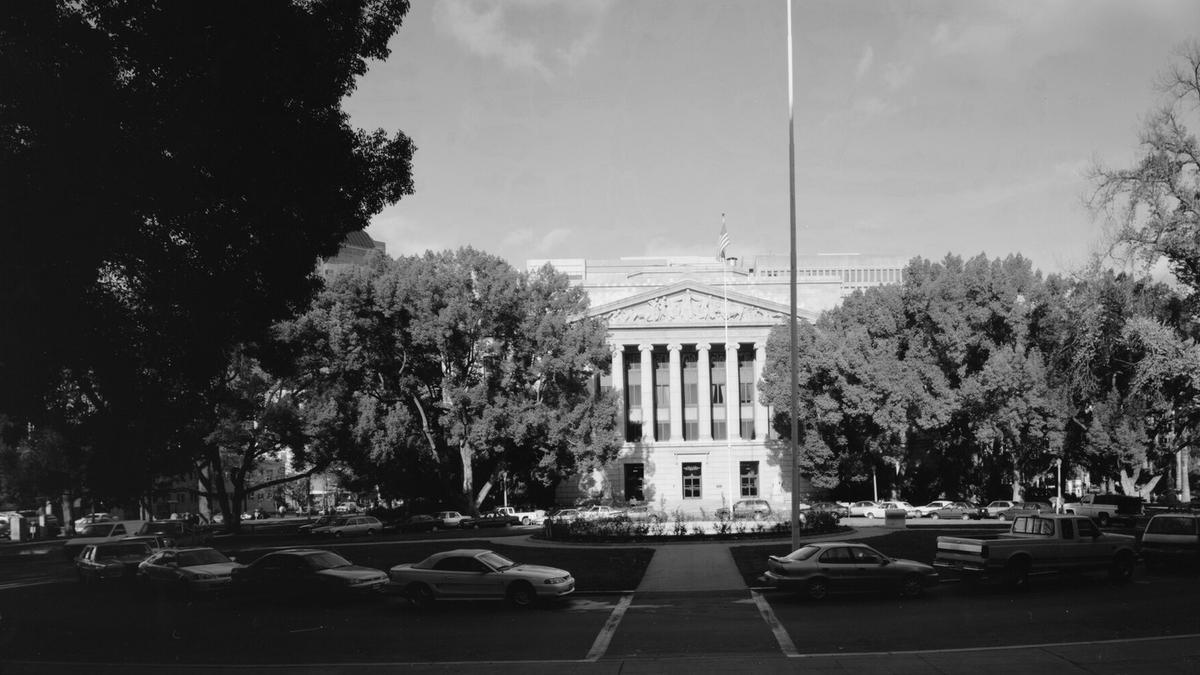
Black and white view of the columned portico of California State Office Building No. 1 on Capitol Mall in Sacramento, framed by trees. Photo: Tom Zimmerman, Historic American Buildings Survey, public domain, via Wikimedia Commons
Prop 40, California's one-time tax on billionaires, is polling ahead, but its opponents are raising as much money to pass two rival measures as to defeat it outright. As of Sunday, Oct. 18, California Secretary of State tallies showed $112.8 million raised to support Proposition 42 and $58.4 million to support Proposition 41, against $114.8 million for committees opposing Prop 40. The reason is a constitutional rule: if either rival gets more yes votes than Prop 40 on Tuesday, Nov. 3, the tax could be stopped even with majority support. That helps explain why Polymarket traders priced Prop 40's chances at 22% on Thursday, Oct. 22, while a September poll found 52% of likely voters in favor.
What Prop 40 Would Tax and Raise
According to the Legislative Analyst's Office analysis of Proposition 40, billionaires who were California residents on Jan. 1, 2026 would owe a one-time state tax equal to 5% of their net worth, due in 2027. Real estate, pensions and retirement accounts generally would be excluded. Ninety percent of the money would go to health care, with the rest for education, food assistance and running the tax.
The analyst's office says the state probably would collect tens of billions of dollars over several years, but calls the amount and timing very hard to predict because much of the wealth rides on stock prices and billionaires may act to cut what they owe. Wealth tied to share prices can swing fast, as TradeFlock covered when billionaires lost $887 billion in two days, and as single fortunes such as Elon Musk's net worth routinely move by billions with one stock. The office also estimates a possible ongoing loss of less than $1 billion a year in income tax if some billionaires leave or shrink taxable income. Because residency is tested as of Jan. 1, 2026, moving now would not avoid the 5% charge, but it would end future state income tax payments. The revenue would sit outside the state spending limit and the school funding guarantee.
How Props 41 and 42 Could Void the Tax
Proposition 41 would nullify state taxes enacted after Jan. 1, 2026 that exclude their revenue from the voter approved spending limit, and would require state auditor reviews of programs funded by new special taxes. Proposition 42 would ban any new state tax on owning personal property, which includes stocks and other financial assets, and any tax applied retroactively based on a taxpayer's past activities. It also nullifies conflicting taxes enacted after Jan. 1, 2026.
The analyst's office review of Proposition 42 spells out the interaction. If Prop 42 receives more yes votes than Prop 40, "then Proposition 40 could be stopped from becoming law even if it gets yes votes from a majority of voters," because courts could find the two conflict. The office uses the same language for Prop 41. Under the California Constitution, when approved measures conflict, the one with the most yes votes prevails. Prop 40's backers therefore need a majority and a bigger yes total than both rivals. Its opponents can win either way.
Where the Campaign Money Is Going
The Secretary of State's Quick Guide to Proposition 40 showed, as of Oct. 18, $32.9 million raised by committees supporting the tax and $114.8 million by committees opposing it. The largest support came from SEIU United Healthcare Workers West, the sponsor. When TradeFlock checked the guide again on Thursday, Oct. 22, nine of the ten largest opposing contributions it listed came from a committee called Building a Better California, ranging from $7 million to $17 million and including $15 million on Oct. 16. The tenth was $5 million from Ripple co-founder Chris Larsen on Feb. 5.
The same committee is the top funder of the rival measures. The Quick Guide to Proposition 42 listed, as of Oct. 18, $112.8 million raised in support and about $1.4 million opposed. Prop 41 supporters had raised $58.4 million as of the same date. On Oct. 9, Building a Better California gave $15 million to the Prop 42 effort and $15 million to the No on 40 side. The state keeps tallies by measure, and a committee active on several measures can appear in more than one, so the totals should be compared side by side rather than added into one campaign figure.
Polls Say Yes, Markets Say Probably Not
The Public Policy Institute of California survey released Sept. 15 found 52% of likely voters would vote yes on Prop 40. But 51% backed Prop 41 and 54% backed Prop 42. The poll of 1,103 likely voters, taken Sept. 4 to Sept. 10, has a margin of error of plus or minus 3.8 points, so the three measures sit within range of one another.
On Polymarket's Prop 40 market, which has drawn about $3.9 million in volume, the yes contract traded at 24.5 cents on Sunday, Oct. 18, and at 22 cents on Thursday, Oct. 22, an implied 22% chance. It was near 29% the day the PPIC poll came out and 31.5% on Oct. 1, according to its price history. A thinly traded market on whether the tax survives the rival measures priced that outcome at 13.5%. Prediction markets are not forecasts and can move on light trading. TradeFlock's reading is that traders are pricing the rival measures, not just the yes and no split on Prop 40.
What to Watch Before Nov. 3
Late polls and late money will show whether Prop 40 can outrun its rivals. If it prevails, the state gains a temporary revenue source aimed at health care, where households already face rising bills such as the 2027 Medicare Part B premium. If a rival wins more votes, the tax could fall despite majority support, and California would also lose the option of future taxes on financial assets.
Cover photo: California State Office Building No. 1 on Capitol Mall in Sacramento, photographed by Tom Zimmerman for the Historic American Buildings Survey (HABS CAL,34-SAC,65-1), Library of Congress, public domain, via Wikimedia Commons (cropped).
Elena Vasquez
Senior Markets Correspondent
Covers Treasuries, the dollar, and the policy signals that reprice risk assets.