Applied Digital Earnings: Interest Expense Tops Base Rent
Applied Digital booked $77.4 million of interest expense against $65.8 million of base rent last quarter. Its 10-Q shows the lease ramp that has to close it.
Senior Markets Correspondent
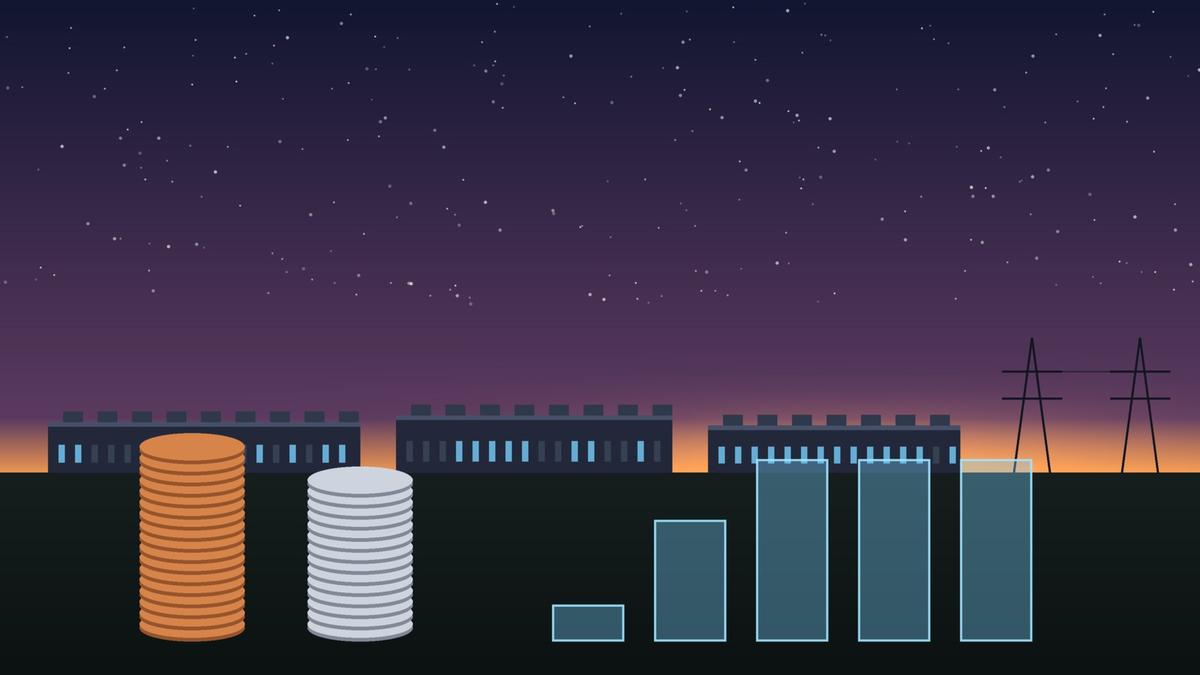
Illustration of AI data halls on a prairie at dusk, with a taller copper coin stack beside a shorter silver one and translucent bars stepping up. Illustration: TradeFlock USA
Applied Digital's interest bill was bigger than its rent roll last quarter. The data center developer booked $77.4 million of interest expense in the three months ended Aug. 31, against $65.8 million of base rent from its AI campuses, according to its quarterly report on Form 10-Q. That is about $1.18 of interest for every $1 of rent. Net of the $35.8 million of interest income it earned on unspent cash, the interest cost was $41.6 million, still close to two thirds of base rent, TradeFlock calculates. The same filing shows why management is asking investors to look past it: the minimum lease payments it is owed jump from $468.0 million over the rest of fiscal 2027 to $1.58 billion in fiscal 2028. Whether Applied Digital earnings turn positive depends on how fast it closes that gap, and the schedule says the swing year is the one that starts next June.
The headline numbers from the earnings release filed on Wednesday, Oct. 7, looked like a breakout. Revenue rose 322% to $341.9 million. Adjusted EBITDA reached $64.4 million, up from $0.5 million a year earlier. The adjusted net loss was $4.1 million, or a penny a share. The net loss from continuing operations attributable to common stockholders was $221.0 million, or $0.76 a share. The stock closed at $23.81 that day, down 6.0% from $25.34 on Tuesday, according to Yahoo Finance price history, and it finished the week at $23.68 on Friday, Oct. 9.
Only One Dollar in Five Was Rent
Most of that 322% growth was construction work, not rent. Applied Digital's HPC hosting business reported $262.6 million of revenue. Of that, $183.5 million came from tenant fit-out services, $65.8 million from base rent and $13.3 million from tenant recoveries, which are pass-through costs the tenant reimburses. Base rent was 19% of total revenue, TradeFlock calculates.
Fit-out revenue is real money, but it carries little profit. Chief Financial Officer Saidal Mohmand said on the earnings call that services cost of revenues included $176.1 million for tenant fit-out work. Set against $183.5 million of fit-out revenue, that leaves about $7.4 million, a margin near 4%, on TradeFlock's math. Rent repeats for the 15-year lease term and earns far more. The company's net operating income on its leased AI buildings was $58.8 million, which Mohmand described as an 89% margin.
The $6.5 Billion Note Stack Behind the Interest Bill
The interest line grew 866% from a year earlier, from $8.0 million to $77.4 million, because the debt stack grew. The 10-Q lists $2.35 billion of 9.25% senior secured notes due December 2030, $2.15 billion of 6.75% notes due March 2031, $1.59 billion of 7.000% notes due June 2031 and $450 million of 2.75% convertible notes due June 2030.
At face value, the coupons on those four note issues add up to roughly $486 million a year, TradeFlock calculates. That excludes the revolver and other smaller debt. The reported interest expense also understates the full cost of borrowing. Applied Digital capitalized $35.7 million of interest into construction costs during the quarter, an amount that will be depreciated over the life of the buildings instead of hitting the income statement now. Added together, interest expense and capitalized interest come to about $113.1 million for the quarter.
Interest income rose to $35.8 million from $0.9 million a year earlier because the company is sitting on unspent bond proceeds. It ended August with $2.9 billion of unrestricted cash and $728.0 million of restricted cash against about $6.4 billion of debt on the balance sheet, Mohmand said; the face value of its borrowings is about $6.7 billion. That cash is earmarked for construction. Purchases of property and equipment ran to $2.07 billion in the quarter, while operating activities produced $63.9 million of cash.
The newest money is cheaper. The $1.59 billion of 7.000% notes closed on Tuesday, June 16, and refinanced a $300 million bridge loan. Mohmand pointed out that the first Polaris Forge 1 notes carried a 9.25% coupon and said the new tranche reflected "the credit enhancements we secured with CoreWeave earlier this year and growing investor confidence in our platform." Its first interest payment is due Tuesday, Dec. 15.
A Lease Schedule That Triples in Fiscal 2028
The figure that best explains the bet is a table near the back of the 10-Q. As of Aug. 31, Applied Digital listed minimum contracted lease payments of $35.73 billion across its signed leases. The schedule runs $468.0 million for the remainder of fiscal 2027, $1.58 billion in fiscal 2028, $2.36 billion in fiscal 2029, and $2.37 billion in each of fiscal 2030 and 2031. The remaining $26.58 billion falls after that. The company's fiscal year ends May 31.
Put those payments next to the coupon estimate and the shape is clear. Nine months of coupons at the current run rate would be about $365 million, so the rest of fiscal 2027 is covered about 1.3 times by contracted rent before any operating costs, on TradeFlock's math. In fiscal 2028, the minimum payments are about 3.2 times a full year of coupons. The lease table excludes tenant reimbursements and variable rent increases, so it is a floor for rent, not a forecast of profit.
Getting there means turning signed megawatts into live ones. The company has leases covering about 1,410 megawatts of critical IT load across five campuses. It had 250 megawatts in service at Polaris Forge 1 in Ellendale, N.D., after the second 75 megawatt phase of Building 2 reached Ready for Service on Thursday, Oct. 1. That is about 18% of the contracted total. Chief Executive Wes Cummins told analysts the company expects "to place over 600 megawatts into service" over the next 12 months, compared with 250 megawatts over the past 12.
The release adds that the company expects delivered critical IT load across its North Dakota campuses to reach 300 megawatts by the end of calendar 2026, with initial operations at Polaris Forge 2 in Harwood. On the call, Cummins said revenue from the Louisiana and Alabama campuses should begin in the first half of calendar 2027. The 210 megawatt Delta Forge 2 lease, signed on Monday, June 8, is expected to be delivered in the first half of calendar 2028.
Where the $221 Million GAAP Loss Came From
The gap between a $4.1 million adjusted loss and a $221.0 million GAAP loss is mostly items management treats as one time or non-cash. Stock-based compensation was $65.4 million, including $41.3 million tied to one-time performance stock units, Mohmand said. The company recorded $67.5 million of non-cash losses on its Babcock and Wilcox warrants and common stock investment, which are marked to market each quarter. The non-GAAP figures also exclude ChronoScale, the roughly 96% owned public subsidiary that reported $41.5 million of revenue, including about $23 million of GPU hardware sales.
The interest bill is not on that list. It stays in the adjusted figures.
Customer concentration is the other risk the filing spells out. One customer, labeled Customer A, accounted for 56% of quarterly revenue, and a second accounted for 21%. Polaris Forge 1 is leased to CoreWeave, while Polaris Forge 3 and both Delta Forge campuses are leased to a single tier-one investment-grade hyperscaler. TradeFlock has covered how CoreWeave's own expansion is being financed, and that tenant's health flows straight into Applied Digital's rent roll.
What the January Report Needs to Show
Cummins closed the call by telling analysts the company would speak to them again in January, when fiscal second-quarter results for the period ending Nov. 30 are due. Three numbers will show whether the rent ramp is on schedule.
First, base rent should rise as a share of revenue. With Building 2 fully live from Oct. 1, the rent line should grow even if fit-out revenue stays high. Second, the gap between interest expense and base rent should narrow. If interest keeps outrunning rent after 300 megawatts are live, the lease schedule is slipping. Third, watch the financing of Polaris Forge 3 and the two Delta Forge campuses. Mohmand said the company is "already in active discussions with leading lending institutions" and expects better terms because the tenant is investment grade.
The backdrop is not getting easier. Local resistance to new data centers is building in states such as Texas, where TradeFlock reported that Gov. Greg Abbott ordered a permit halt, and Cummins argued that each new restriction elsewhere makes campuses that are already powered harder to replicate. Hyperscalers are also tapping bond markets on their own, as in Meta's bond offering of up to $30 billion, which sets the price that developers like Applied Digital compete against.
The company says it expects about 250 megawatts of expansion leases by calendar year end at what Cummins called "materially higher pricing." Until those buildings deliver, the clearest test of the story sits in one comparison: last quarter, interest expense of $77.4 million against base rent of $65.8 million.
Illustration: TradeFlock USA
Elena Vasquez
Senior Markets Correspondent
Covers Treasuries, the dollar, and the policy signals that reprice risk assets.