Why Moderna Stock Jumped: NIH Cancer Vaccine Plan in Context
The NIH plan recommends $200 million over three years. Moderna spent $198 million, net of Merck, on one cancer vaccine in six months, its 10-Q shows.
Senior Markets Correspondent
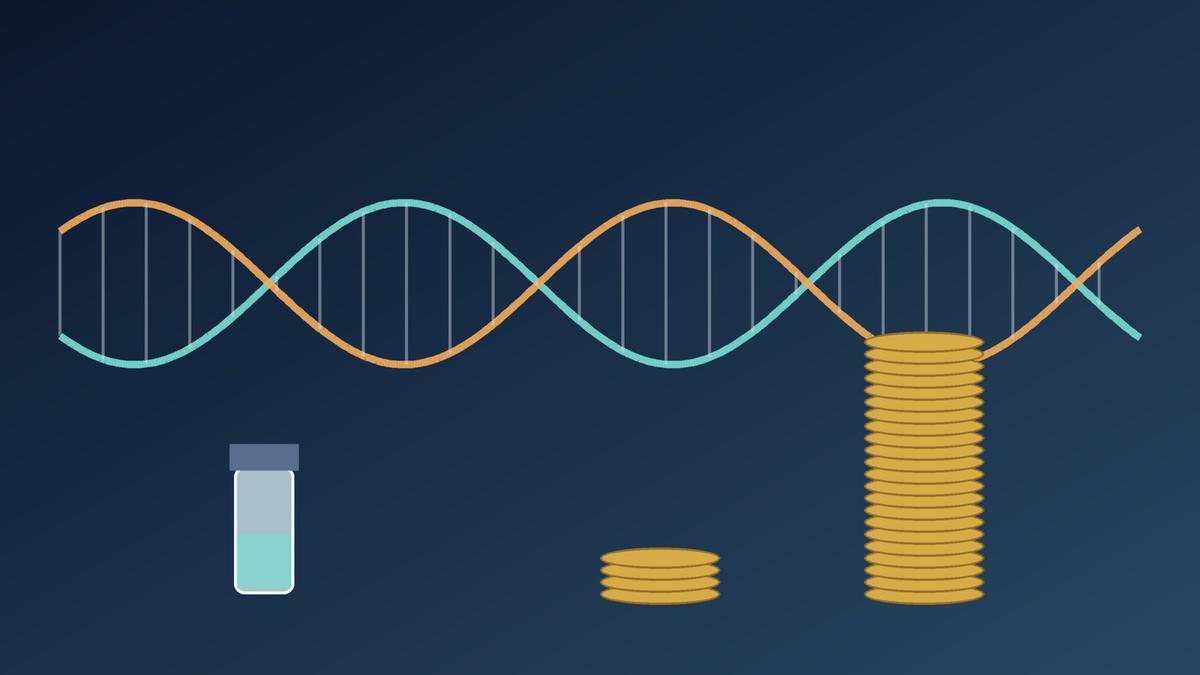
Illustration of a twisting RNA strand above a small vaccine vial, a short coin stack and a much taller coin stack on a dark blue background. Illustration: TradeFlock USA
The federal cancer vaccine plan that helped lift Moderna stock to a four-year high is smaller than Moderna's own spending on a single cancer vaccine. The Therapeutic Cancer Vaccines Initiative recommends $200 million over three years, half of it federal, or about $67 million a year. Moderna's quarterly report shows it spent $198 million, after Merck's cost sharing, on its personalized cancer vaccine with Merck in just the first half of 2026, TradeFlock calculates from the filing. On Friday, Moderna added about $11.2 billion in market value, roughly 56 times the initiative's entire three-year budget. That gap is the clearest answer to the question investors searched all weekend: why did Moderna stock jump?
Why Moderna Stock Jumped on Friday
Moderna closed at $225.00 on Friday, Oct. 9, up 14.2% from $197.00 a day earlier, according to Yahoo Finance price data. Two things landed on the same morning.
The first was mechanical. Nasdaq said on Oct. 1 that Moderna would join the Nasdaq-100 index, replacing Warner Bros. Discovery before the market opened on Friday, Oct. 9. Index funds that track the Nasdaq-100 had to own the shares by then, which creates real but one-time demand.
The second was a New York Times report that the National Institutes of Health plans a national push on cancer vaccines, built on the public-private model that sped up COVID vaccines. The Foundation for the NIH, which is running the effort with the National Cancer Institute, says on its program page that the initiative will unite government, academia, life sciences companies, philanthropy and patients to move promising vaccines into rigorous clinical studies. The Times did not name participating companies, but investors treated Moderna, the best-known developer of messenger RNA medicines, as the obvious beneficiary.
What the NIH Plan Actually Funds
The dollar figures come from the initiative's executive summary, published by the Foundation for the NIH. It recommends "an initial $200 million investment over the first three years" to establish what it calls a National Cancer Vaccine Ecosystem. The figure is a recommendation in the initiative's white paper, not money Congress has appropriated. Federal investment of $100 million "provides the foundation for shared infrastructure and precompetitive science," while companies, philanthropy, foundations and technology partners are expected to contribute the other $100 million. The long-term target is "largely democratized therapeutic cancer vaccine access by 2035."
Spread evenly, that is about $66.7 million a year in total and about $33.3 million a year in federal money, TradeFlock calculates. It pays for shared trial networks, shared data and common infrastructure. It is not a purchase commitment, and nothing in the summary promises money to any single company.
The target cancers matter too. The summary points to cancers "such as pancreatic, liver, ovarian, high-risk colorectal, and many pediatric malignancies," where recurrence is common and few therapies prevent relapse. Melanoma, where Moderna's most advanced cancer vaccine has produced its Phase 3 result, is not on that list.
Moderna's Own Cancer Vaccine Bill
Moderna does not carry its lead cancer program alone. Its quarterly report for the period ended June 30, 2026 says Moderna and Merck agreed to develop intismeran autogene, an individualized neoantigen therapy, "with costs and any profits or losses generally shared equally on a worldwide basis." Moderna mainly handles process development and manufacturing, while Merck generally leads the clinical trials. Merck paid a $250 million option fee in October 2022.
The filing puts Moderna's share of the cost in plain numbers. It recognized expenses, net of Merck's reimbursements, of $97 million in the second quarter and $198 million in the first half of 2026 on the program, compared with $99 million and $203 million a year earlier.
That means Moderna's own half of one cancer vaccine program costs about as much in six months as the entire NIH initiative plans to spend in three years. At the first half pace, Moderna's net spending would be about $396 million a year, nearly six times the initiative's yearly budget and about 12 times its yearly federal share, TradeFlock calculates. Because Merck pays roughly the other half, the full program costs more still.
The broader research budget is larger again. Moderna spent $651 million on research and development in the second quarter, down from $700 million a year earlier, and $1.3 billion in the first half. At the second quarter pace, it spends the initiative's full $200 million in about 28 days, TradeFlock calculates.
The Phase 3 Result Behind the Optimism
The cancer story did not start on Friday. On Aug. 19, Merck and Moderna announced that the Phase 3 INTerpath-001 trial of intismeran plus Merck's Keytruda met its primary endpoint of recurrence-free survival and a key secondary endpoint of distant metastasis-free survival in patients with completely resected stage IIB to IV melanoma. The companies called it the first positive Phase 3 readout for an mRNA-based cancer therapy.
The result came at a pre-specified interim analysis, and the study continues to measure overall survival. The topline release did not give the size of the benefit. Those details, not federal infrastructure money, are what will decide whether the program becomes a commercial product. Late-stage data, not early-stage funding, tends to set value in drug development, a theme that also runs through TradeFlock's look at the patent cliff facing Pfizer's next commercial chief.
The Cash Burn the Rally Skips
The same filing shows a company still losing money at a fast clip. Second quarter revenue was $145 million, with net product sales of $94 million, mostly COVID vaccines. The operating loss was $815 million, about 5.6 times revenue, TradeFlock calculates. Net loss for the first half was $2.1 billion.
Cash, cash equivalents and investments fell by $1.2 billion, or 15%, in the first six months, the 10-Q says, driven by a $1.2 billion operating cash outflow and $99 million of capital spending. At June 30, Moderna held $1.72 billion in cash and cash equivalents, $3.42 billion in current investments and $1.77 billion in non-current investments, about $6.91 billion in all. At the first half rate of about $1.26 billion every six months, that would last a little under three years, TradeFlock calculates, before counting any revenue growth or cost cuts.
Moderna also has a term loan facility with $1.5 billion of commitments: a $600 million initial loan funded at closing and maturing in November 2030, plus $900 million of delayed draw commitments. Part of that, $500 million, is available only if the company hits specified regulatory approval milestones.
What the Initiative Could Still Mean
None of this makes the NIH plan irrelevant to Moderna. Shared trial networks and shared data could make studies cheaper and faster to run, which would help any company with candidates in the target cancers. A federal signal that cancer vaccines are a national priority can matter even when the dollars are modest, much as smaller awards such as the NIH grant TradeFlock covered for Airway Therapeutics can help a program move into the clinic.
But the scale is clear. On Friday, Moderna's market value rose from about $78.6 billion to about $89.8 billion, using the 399.2 million shares it reported outstanding in late July, TradeFlock calculates. The initiative's total three-year budget equals less than 2% of that one-day gain.
What to Watch Next
Three things will test the rally. First, the full INTerpath-001 data, including the hazard ratio for recurrence-free survival, which the companies plan to reveal later this month, according to the Times. Second, Moderna's third quarter report, which will show whether net spending on the Merck program and the cash balance keep moving at the first half pace. Third, the initiative's launch, which a Foundation for the NIH official told the Times is expected to begin in December, and the list of companies that sign on as partners, which will show whether Moderna has a formal role at all.
Illustration: TradeFlock USA
Elena Vasquez
Senior Markets Correspondent
Covers Treasuries, the dollar, and the policy signals that reprice risk assets.