Bessent Warren Buyback Fight: Why $12B Cost Only $7.7B
Treasury's two latest long-end buybacks retired $12 billion of bonds at face value for about $7.7 billion in cash. The discount reflects low coupons, not a profit.
Senior Markets Correspondent
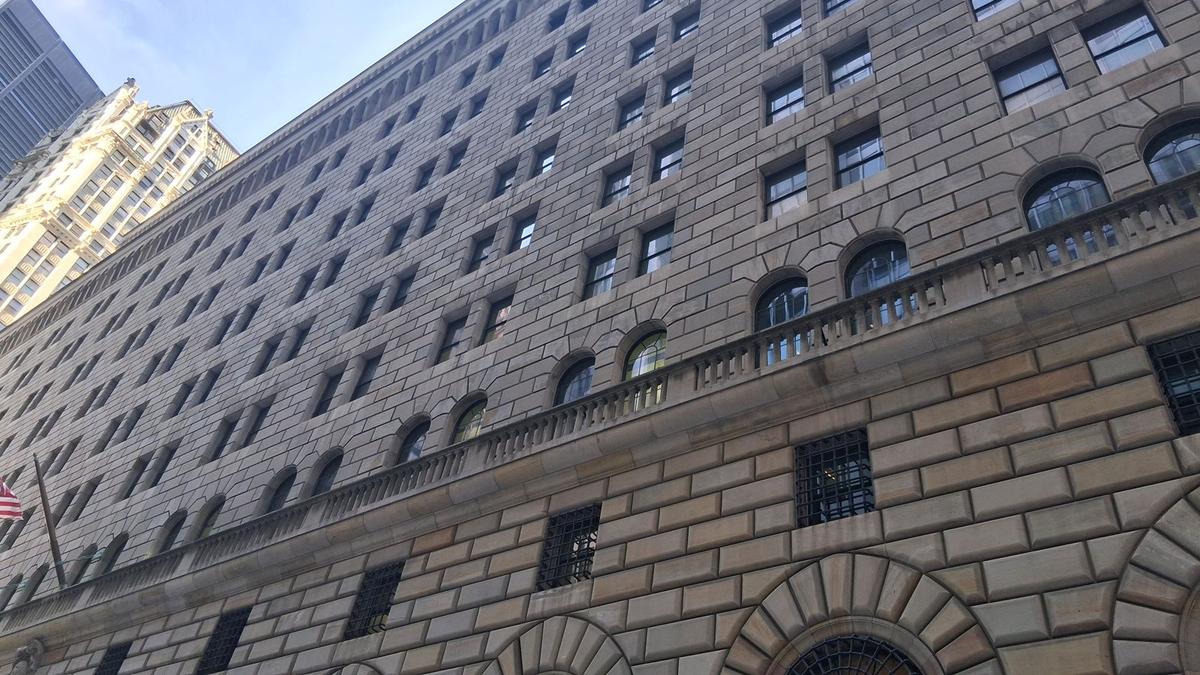
Upward view of the limestone facade and arched windows of the Federal Reserve Bank of New York building. Photo: Kidfly182 via Wikimedia Commons, CC BY 4.0
Treasury Secretary Scott Bessent defended the government's bond buyback program in a Saturday letter to Sen. Elizabeth Warren, Fox Business reported on Oct. 10. The operation results tell a story neither side has spelled out. In its two most recent long-dated buybacks, on Oct. 1 and Oct. 8, Treasury retired $12 billion of bonds at face value, but because it bought old low-coupon bonds trading far below par, the cash cost was about $7.7 billion before accrued interest, by TradeFlock's estimate. On Oct. 8 the average accepted price was about 55 cents on the dollar.
Treasury Buyback Results at the Center of the Bessent Warren Fight
Warren's Oct. 7 letter, posted on the Senate Banking Committee website, called the buybacks "unprecedented and chaotic interventions in the market" and said "your intervention is failing." She listed three operations, $5.2 billion on Sept. 10, $4.1 billion on Sept. 24 and $6 billion on Oct. 1, and asked Treasury to say by Oct. 21 whether it plans to draw down its cash account to expand them. According to Fox Business, which obtained the reply, Bessent wrote that "It is difficult to treat your concern as sincere" and offered her "a Foreign Exchange for Dummies tutorial."
The program change at the center of the fight came on Wednesday, Aug. 19, when Treasury announced that the maximum size of liquidity support buybacks in the 10 to 20 year and 20 to 30 year sectors would rise from $2 billion per operation to "at least $4 billion," effective Sept. 9 through Nov. 4. Treasury said the move reflected "the significant volume of high-quality offers Treasury routinely receives in longer-dated buyback operations." In practice the cap went to $6 billion, three times the old limit, in both October long-end operations.
Inside the Oct. 1 and Oct. 8 Results
The Oct. 1 results show dealers and investors offered $46.4 billion of bonds maturing between 2037 and 2046 against the $6 billion cap, nearly eight times the amount Treasury would take. Treasury accepted just two issues: $4.95 billion of the 3.25% bond due May 2042 at a weighted average price of $75.976 per $100 of face value, and $1.05 billion of the 2.25% bond due May 2041 at $67.398. By TradeFlock's estimate, the cash outlay for that $6 billion of face value was about $4.47 billion.
The Oct. 8 operation, for bonds due between 2046 and 2056, drew $14.9 billion of offers and again filled the full $6 billion. The largest piece was $2.62 billion of the 2.25% bond due August 2049 at $56.117, and Treasury paid as little as $46.844 for the 1.625% bond due November 2050. Weighting every accepted issue, the average price was about $54.57, which puts the cash cost near $3.27 billion, by TradeFlock's estimate. The two operations together retired $12 billion of face value for roughly $7.74 billion, a gap of about $4.3 billion. That gap is not a saving. Treasury paid market prices, and the bonds trade below par because their 1.625% to 3.375% coupons are far below today's yields; retiring them early swaps cheap old debt for cash that is likely refinanced at higher rates, TradeFlock notes.
Did the Buybacks Move Yields?
Warren wrote that yields rose on the days of the first two upsized operations and dipped on the third before climbing again. FRED data on the 10-year Treasury back that up: it rose from 4.83% on Sept. 9 to 4.95% on Sept. 10, rose again from 5.11% to 5.18% on Sept. 24, and slipped to 5.24% on Oct. 1 before returning to 5.28% on Oct. 2. The fourth operation, on Oct. 8, came after her letter. That day the 10-year fell to 5.22% from 5.28%, and the 30-year yield fell to 5.60% from 5.67%. The 30-year was still up from 5.28% on Sept. 9, the day before the first upsized operation.
What This Means for Bond Investors
The face value figures that dominate the political debate overstate how much cash Treasury is putting into the long end. Each upsized long-end operation can absorb $6 billion of face value, but at today's prices it costs far less, because the bonds being offered back are older issues with coupons of 1.625% to 3.375% that trade at deep discounts when yields sit above 5%. That makes the operations a tool for clearing out hard-to-trade, low-coupon bonds, which is how Treasury describes them, more than a large cash bid for long-term debt. TradeFlock reported in September that Treasury buybacks were staying small. The October results show sizes have since tripled, while cash outlays remain modest.
The next decision point is Nov. 4, when Treasury said it will give more information about buyback sizes at its quarterly refunding. Warren's Oct. 21 deadline for written answers falls two weeks earlier. For investors, the yield backdrop matters more than either letter, as TradeFlock covered in how surging Treasury yields complicate Federal Reserve policy and in its look at JPMorgan's 6.5% bond pitch.
Cover photo: Federal Reserve Bank of New York building, by Kidfly182 via Wikimedia Commons, CC BY 4.0.
Elena Vasquez
Senior Markets Correspondent
Covers Treasuries, the dollar, and the policy signals that reprice risk assets.