December 30, 1936: The First Sit-Down Strike in US History
Space exploration has been one of humanity's most technologically advanced achievements. However, only a few countries worldwide, such as the US, Russia, China, and India, have developed space exploration vehicles from the ground up.
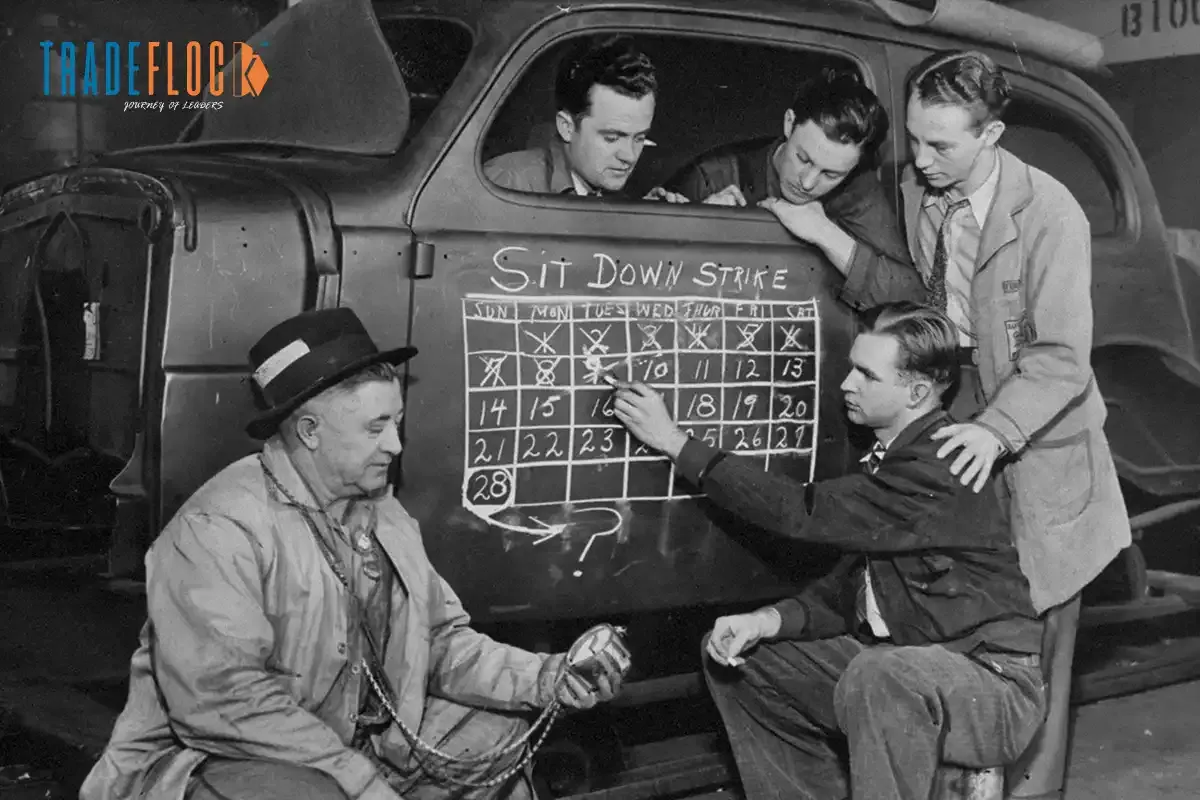
In the first half of the 20th century, a new system of governance was taking over the world: Communism. And the shade of communism was also looming large on the US. This gave rise to something unprecedented. On December 30th 1936, a group of automobile workers in Flint, Michigan, initiated what would become the first large-scale sit-down strike in US history, fundamentally altering the balance of power in the United States.
The strike targeted General Motors’ Fisher Body plants, critical nodes in GM’s production network, and lasted 44 days, ending in February 1937. Its outcome forced General Motors, then the largest corporation in the world by revenue, to formally recognize the United Automobile Workers (UAW) as the bargaining representative for its employees. This single labor action reshaped American unionism, accelerated the growth of industrial unions, and established a new legal and tactical precedent for collective bargaining.
The Backdrop
The Flint sit-down strike occurred against the backdrop of the Great Depression, during which U.S. unemployment peaked at approximately 25 per cent in 1933. Industrial workers faced widespread wage cuts, job insecurity, and hazardous working conditions. In response to mounting labor unrest, the federal government enacted the National Labor Relations Act (Wagner Act) of 1935, which guaranteed workers the right to organize, form unions, and engage in collective bargaining.
Despite the Wagner Act, enforcement remained inconsistent, and many corporations, including General Motors, actively resisted unionization through surveillance, firings, and company-controlled employee associations.
Why Flint and Fisher Body?
Now, the question is: why Flint? And Why Fisher Body? Well, Flint, Michigan, was the General Motors operational heart. The Fisher Body plant, by contrast, produced automobile bodies, which were critical to final assembly, creating a strategic vulnerability in GM’s production system. By acquiring these plants and not leaving them, workers made sure that the production was halted and they are not replaced by more labor.
On December 20, 1936, UAW members occupied Fisher Body Plant No. 1, soon followed by Plant No. 2. At its peak, the strike involved approximately 1,800 sit-down strikers and idled nearly 135,000 GM workers nationwide due to parts shortages.
Escalation and State Intervention
General Motors was one of the biggest companies in the US at the time and was cozy with the administration; as a result, they sought court orders to evict the strikers in an attempt to regain control of the plant. This resulted in a violent confrontation outside Fisher Body Plant No. 2 on January 11, 1937, later known as “Battle of Running Bulls”. Police did everything in their power, including tear gas, clubs, and you name it, but the strikers replied with fire hoses, car door hinges, and other objects they could throw at them.
The confrontation resulted in multiple injuries but no fatalities. Michigan Governor Frank Murphy refused GM’s request to deploy the National Guard to remove the strikers, instead stationing troops to prevent further violence and protect the occupied facilities.
Resolution and GM’s Recognition of UAW
After 44 days of halted production and mounting financial losses estimated at approximately $30 million (equivalent to over $650 million today when adjusted for inflation), General Motors agreed to negotiate. On February 11, 1937, GM formally recognized the United Automobile Workers as the exclusive bargaining representative for its employees and agreed to reinstate strikers without retaliation.
This marked the first time a major U.S. industrial corporation recognized an industrial union following direct worker action rather than prolonged arbitration. UAW membership surged from approximately 30,000 in 1936 to over 400,000 by the end of 1937, largely due to the Flint victory.
Legal and Strategic Consequences
This sit-down strike is what some would call ‘opening of the Pandora box’ as it gave rise to various other strikes in different parts of the country. Between 1936 and 1937, the United States of America recorded a mind-numbing 470 sit-down strikes, involving over 400,000 workers, mostly in steel, rubber, and automotive manufacturing.
However, the tactic also prompted legal backlash. In 1939, the U.S. Supreme Court ruled sit-down strikes illegal in NLRB v. Fansteel Metallurgical Corp., effectively ending their use as a lawful labor strategy. Despite this, the gains secured through Flint remained intact.
Long-Term Impact on American Labor
The Flint sit-down strike permanently altered labor relations in the United States. It accelerated the rise of the Congress of Industrial Organizations (CIO), legitimized mass industrial unionism, and forced corporations to recognize organized labor as a permanent negotiating force. By 1941, union membership in the U.S. had doubled compared to pre-strike levels, fundamentally reshaping wages, benefits, and workplace safety standards for industrial workers.
The strike stands as one of the most consequential labor actions in American history, not because of rhetoric or symbolism, but because of measurable outcomes: union recognition, membership growth, and structural change in corporate labor relations.
Share this article Latest News Categories More News