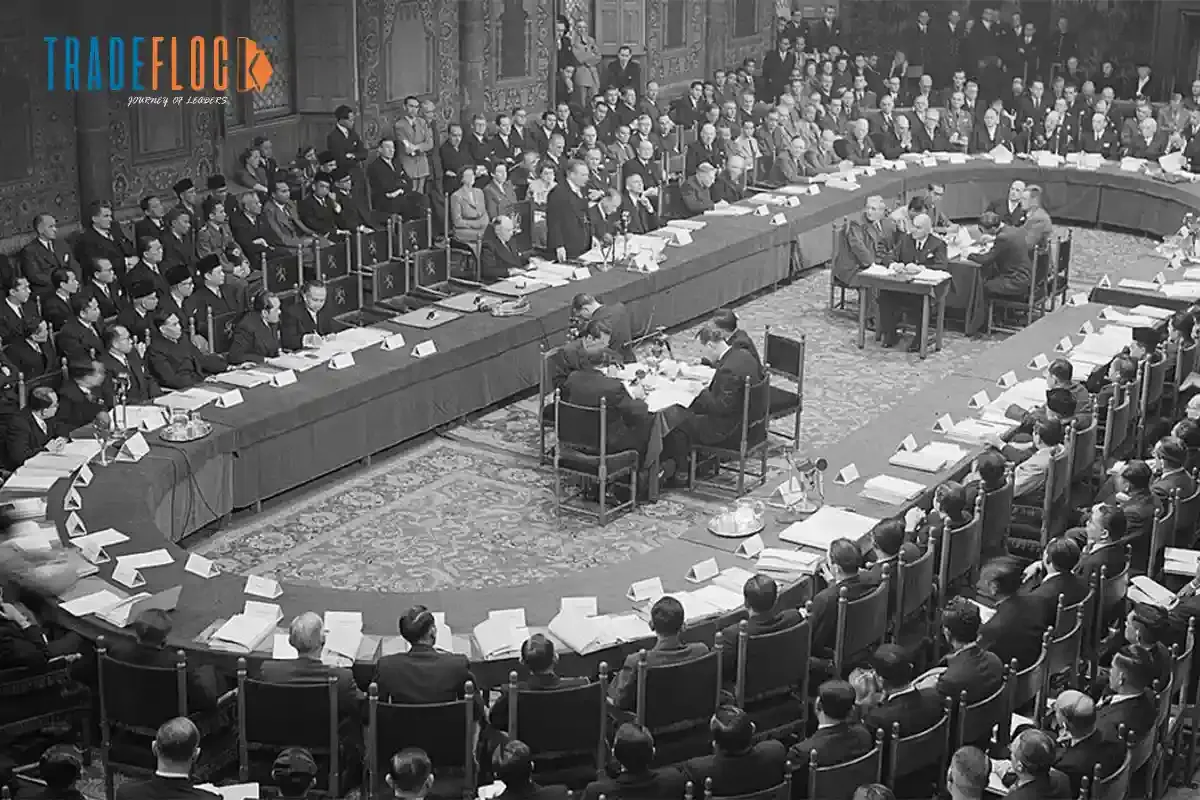
November 12, 1930: The First Round Table Conference
The great struggle for Indian independence began on November 12, 1930, at the grand St. James's Palace in London. The First Round Table Conference, a gathering organised by the British government, was more than just a diplomatic event; it was an effort to redefine the constitutional relationship between Britain and its
The great struggle for Indian independence began on November 12, 1930, at the grand St. James's Palace in London. The First Round Table Conference, a gathering organised by the British government, was more than just a diplomatic event; it was an effort to redefine the constitutional relationship between Britain and its largest colony. It served as a political experiment amid the Civil Disobedience Movement and growing Indian nationalism, reflecting the imperial dilemma: how to maintain global rule while responding to the unstoppable demand for self-governance.
Setting the Stage: Britain’s Balancing Act
It is my conviction that the political situation in India was heating up by 1930. The Indian National Congress, led by Mahatma Gandhi, Jawaharlal Nehru, and Sardar Vallabhbhai Patel, was insisting on Purna Swaraj, full independence. The Salt March of the previous year had mobilised the masses, and British rule seemed increasingly unsatisfactory. However, the British government, led by Prime Minister Ramsay MacDonald, attempted a compromise to grant India partial independence but maintain imperial control.
This tension led to the First Round Table Conference. It was meant to address constitutional reforms in line with the recommendations of the Simon Commission, which had excluded Indians, causing widespread protests. The conference was, on one hand, a gesture of inclusion by Britain; on the other, it stood as a test of good faith on India's part.
A Conference Without Its Core Voice
The conference on November 12, 1930, opened with King George V’s grand speech at St. James’s Palace, attended by 89 Indian representatives, including princes, landlords, minorities, and reformers. The Indian National Congress boycotted, protesting civil disobedience and oppression, which overshadowed the event. Without Congress, the main Indian nationalist body, the meeting risked becoming merely practical talk rather than a reform effort. Despite this, the British government reiterated its commitment to constitutional progress.
The Participants: Voices from a Fragmented Nation
The conference, even without Congress, united diverse political players. Representatives from Indian princely states saw it as a way to gain more autonomy within a federal system. Muslim leaders like Aga Khan and Muhammad Shafi pushed for separate electorates and minority protections, influencing later partition politics.
Dalit leader Dr B.R. Ambedkar used the forum to highlight social injustices faced by the Depressed Classes, arguing that social emancipation was vital for political reform. His statements were among the first international acknowledgements of caste discrimination as a barrier to democracy.
Participants included Sikhs, Christians, Anglo-Indians, and business representatives, each with their own interests. The conference reflected India’s societal diversity but also revealed challenges in reaching consensus.
The Core Debate: Dominion, Federation, or Control?
The debate centred on India's future governance. British officials proposed a federal model for British India and princely states united under one constitution, hoping to balance local autonomy and imperial control. Critics argued it aimed to weaken nationalist efforts and maintain British dominance through princely unions.
Many Indian delegates viewed federation as an opportunity, offering a vision of a united India under shared institutions, though with limitations. Yet, without Congress's involvement, it remained just a theory.
To keep progress, the British promised future inclusion of major political groups, including Congress, once law and order was restored, paving the way for other conferences.
Achievements and Limitations
The First Round Table Conference succeeded in accomplishing something unusual: it included Indian voices in official constitutional discussions on an equal footing with the British. The idea of India as an autonomous federation was addressed for the first time. The demand of the Depressed Classes by Ambedkar, the request for recognition by the princely states, and the call for mechanisms of protection by minority leaders all pushed constitutional reform in a broader direction.
However, the absence of the Congress Party made such discussions politically empty. By the end of the conference in January 1931, no binding resolutions were adopted. The British government was not serious about the reforms, and the mass movement toward independence in India did not decline.
Aftermath and Legacy
Following the collapse of the First Round Table Conference, the British aimed to negotiate directly with Congress. This led to the signing of the Gandhi-Irwin Pact in March 1931, which temporarily halted the Civil Disobedience Movement and allowed Congress to participate in the Second Round Table Conference later that year.
Although the initial conference did not produce immediate change, its symbolic importance was significant. It marked the first time the British officially recognised the need for Indian involvement in shaping their own governance. The discussions initiated at St. James's Palace laid the groundwork for the Government of India Act of 1935, the most substantial constitutional amendment before independence.
A Beginning in Dialogue
The November 1930 First Round Table Conference was a political experiment within the empire. It did not bridge the gap between colonial objectives and nationalist aspirations, but it marked the beginning of a process that over the next 17 years would dismantle the very structure it was intended to support. In the elegant rooms of St. James Palace, not only were speeches and declarations made, but also the early signals of India's future as a democratic nation, one built through debate, inclusion, and the unwavering exercise of self-governance.
Share this article
Latest News
Categories
More News